Somalia and its neighbours: key economic figures compared
Tusmada
Growth, income, prices, investment, remittances, electricity and internet use in Somalia, Kenya, Ethiopia, Djibouti, Uganda and Tanzania, from one consistent source, plus Somalia's regional trade memberships.
Not investment advice. Independent summary of official and international statistics. The Government of Somalia has not endorsed it.
Last checked: 30 September 2026.
Summary
Comparing Somalia with its neighbours helps members judge where it stands and where the gaps and openings are. Using one consistent source for each figure:
- Income: Somalia has the lowest income per person of the six countries compared, about US$661 in 2025 in World Bank data, against about US$933 in Ethiopia and US$2,363 in Kenya.
- Growth: Somalia grew about 3% in 2025, the slowest of the six. Ethiopia grew fastest, at about 9.8%.
- Prices: Somalia's inflation averaged 3.7% in 2025 (Central Bank of Somalia), similar to Kenya, Uganda and Tanzania and well below Ethiopia's 13.2%.
- Investment: Somalia recorded US$765 million of foreign direct investment in 2024, more than Kenya or Djibouti but far less than Ethiopia or Uganda.
- Remittances: net private transfers, mainly remittances, are worth about a fifth of Somalia's GDP (IMF, 2024). In the neighbouring countries, personal remittances are 1–5% of GDP (World Bank), though the two measures are not identical.
- Regional trade: Somalia joined the East African Community in March 2024 and deposited its ratification of the African Continental Free Trade Area agreement in September 2026.
These figures come from different statistical systems and should be read with the notes below.
The figures
| Indicator | Somalia | Kenya | Ethiopia | Djibouti | Uganda | Tanzania | Year |
|---|---|---|---|---|---|---|---|
| Population (millions) | 19.7 | 57.5 | 135.5 | 1.2 | 51.4 | 70.5 | 2025 |
| GDP (US$ billion) | 13.0 | 135.9 | 126.4 | 4.6 | 62.0 | 90.1 | 2025 |
| GDP per person (US$) | 661 | 2,363 | 933 | 3,906 | 1,206 | 1,319 | 2025 |
| Real GDP growth (%) | 3.0 | 4.6 | 9.8 | 6.5 | 6.3 | 5.9 | 2025 |
| Inflation (%) | 3.7 (a) | 4.1 | 13.2 | -0.3 | 3.6 | 3.3 | 2025 |
| Foreign direct investment, net inflows (US$ million) | 765 | 463 | 4,022 | 68 | 3,257 | 1,718 | 2024 |
| Remittances received (% of GDP) | 19.8 (b) | 4.2 | 4.8 | 1.3 | 2.7 | 1.4 | 2024 |
| Exports of goods and services (% of GDP) | 29.2 | 15.8 | 13.3 | 110.5 | 21.4 | 19.0 | 2025 |
| Access to electricity (% of people) | 54.4 | 77.0 | 56.6 | 69.2 | 55.3 | 52.4 | 2024 |
| Internet users (% of people) | 27.9 | 35.0 | 21.9 | 65.3 | 8.9 | 31.2 | 2024 |
Source: World Bank, World Development Indicators (updated 13 July 2026), except: (a) Central Bank of Somalia, because the World Bank has no value for Somalia; (b) IMF, net private transfers, mainly remittances. The World Bank has no value for Somalia, and the IMF measure is not identical to the World Bank's personal remittances.
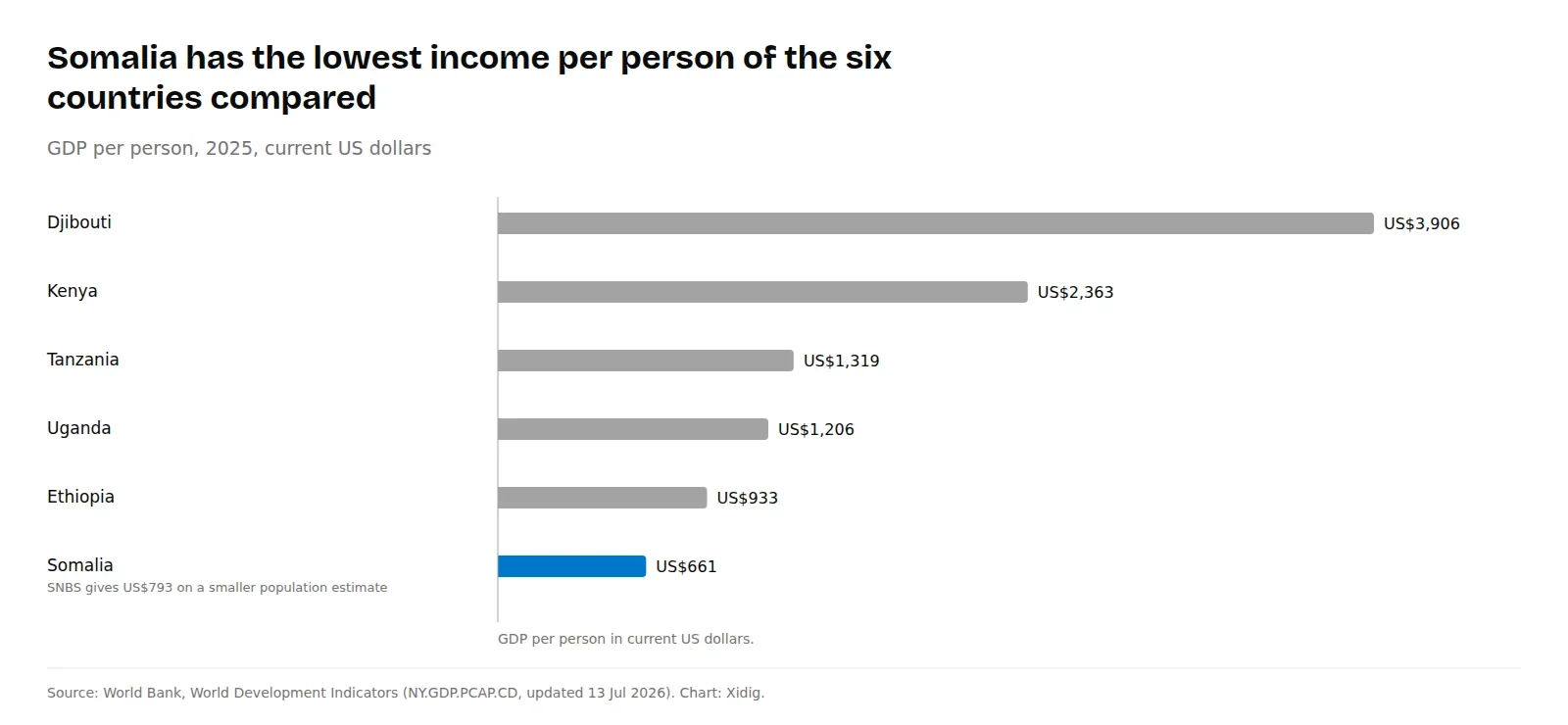
GDP per person in 2025. Somalia's official statistics office gives a higher figure (US$793) because it uses a smaller population estimate.
What the figures mean
Growth and size.
- Somalia's official revision: the World Bank's figures for Somalia still use the earlier official series. The Somali National Bureau of Statistics (SNBS) revised it in June 2026, giving GDP of US$13.2 billion and growth of 3.1% in 2025. The two series are close for 2025. See Somalia's economy at a glance.
- Ethiopia's currency float: Ethiopia's GDP in US dollars fell in 2025 even though its economy grew about 9.8%. Ethiopia let the market set the value of its currency, the birr, on 29 July 2024, so its output is worth fewer dollars.
- Forecasts: for 2026 the IMF expected Somalia to grow 2.6% (April 2026), and the World Bank "about 2.8 percent" (Macro Poverty Outlook, April 2026). Xidig could not retrieve a consistent set of 2026 forecasts for all six countries.
Income per person and population. Figures per person depend on the population used. The World Bank uses about 19.7 million people for Somalia; SNBS gives US$793 per person, which implies a smaller population of about 16.7 million (the government's investment booklet gives about 16.3 million). Somalia has had no recent census.
Prices.
- Somalia: inflation averaged 3.7% in 2025 but rose above 8% in May and June 2026 before easing to 6.7% in July (SNBS). The economy is largely dollarised; the planned return of the Somali shilling is covered in The new Somali shilling: what's changing, and when.
- Djibouti: its franc is fixed to the US dollar. The central bank says "Le franc Djibouti est rattaché au dollar US par une parité fixe de 177.721 francs Djibouti pour 1 dollar US" (the Djibouti franc is pegged to the US dollar at a fixed rate of 177.721 francs per dollar).
- Kenya: its central bank aims to keep inflation "within the 5.0±2.5 percent target range" (Central Bank of Kenya, October 2025 policy report, published December 2025).
Investment. Somalia's foreign direct investment (US$765 million in 2024) was larger than Kenya's that year, in World Bank data, but small compared with Ethiopia's or Uganda's. The Central Bank of Somalia reports US$880 million for 2025.
Remittances. The IMF puts Somalia's net private transfers, mainly remittances, at about 19.8% of GDP in 2024. In the neighbouring countries, the World Bank's personal remittances are 1–5% of GDP. The two measures differ, but the gap is large enough to show that remittances matter far more to Somalia. See Remittances to Somalia: what the numbers mean.
Trade.
- Exports: Somalia's exports of goods and services were about 29% of GDP in 2025. The Central Bank of Somalia reports goods exports of US$1.26 billion against goods imports of US$7.30 billion in 2025.
- Djibouti: its exports are larger than its GDP because they include port and transit services for its neighbours.
Electricity and internet.
- Electricity: about 54% of Somalis had access to electricity in 2024, similar to Ethiopia, Uganda and Tanzania, and below Kenya (77%). Access is not the same as reliable supply: the World Bank's 2026 Somalia Economic Update, based on household reports, gives a higher access figure (71% of households) but finds that only 21% get more than eight hours of supply a day.
- Internet: about 28% of Somalis used the internet in 2024, more than in Ethiopia or Uganda but less than in Kenya, Tanzania or Djibouti. These are estimates by the International Telecommunication Union (ITU); Uganda's low figure should be read with care.
Regional trade agreements.
- East African Community (EAC): "The Federal Republic of Somalia has finally joined the East African Community as the bloc's 8th Partner State" after depositing its instrument of ratification on 4 March 2024 (EAC Secretariat).
- COMESA: Somalia joined the Common Market for Eastern and Southern Africa in July 2018, as its 21st member.
- IGAD: Somalia is a member of the Intergovernmental Authority on Development, with Djibouti, Ethiopia, Kenya, South Sudan, Sudan and Uganda.
- African Continental Free Trade Area (AfCFTA): Somalia deposited its instrument of ratification at the African Union on 4 September 2026, according to tralac; Dawan also reported the deposit. The House of the People had approved the agreement in October 2025. Tralac notes that Somalia still has to load its AfCFTA tariff schedule into its customs system before trade under the agreement starts.
Other neighbours. South Sudan and Eritrea are not in the table because the World Bank has no recent figures for most indicators. Sudan is left out because war has disrupted its economy and its data.
What this means (Xidig's interpretation). Somalia is the poorest of these six economies per person and grows more slowly, but it is not an outlier on prices, electricity access or investment. Its distinctive features are its reliance on remittances and imports, and its new place in regional trade blocs, which could open neighbouring markets to Somali traders once the agreements are fully applied.
Where Xidig members may contribute
- Business plans and grant applications: cite the linked sources and years, not this page's rounded figures.
- Market research: compare prices, power costs and connectivity when deciding where to base a regional business.
- Trade: follow how the EAC and AfCFTA rules are applied at Somali customs.
What is confirmed, and what isn't
Confirmed
- World Bank figures for all six countries, as published on 13 July 2026.
- Somalia's inflation (Central Bank of Somalia) and net private transfers (IMF).
- Somalia's EAC accession (March 2024) and COMESA membership (2018).
Our interpretation
- Remittances and imports are what most set Somalia apart from its neighbours.
Not yet verified
- A consistent set of 2026 forecasts for all six countries.
- The African Union's own record of Somalia's AfCFTA ratification. An AfCFTA Secretariat page from February 2026 already called Somalia "the 50th State Party", before the September 2026 deposit reported by tralac and Dawan.
More about the source
- Primary sources: World Bank, World Development Indicators (updated 13 July 2026); Central Bank of Somalia, Annual Report 2025; IMF Country Report 25/335.
- Booklet figures: the government's investment booklet, Bankable Projects 2026–2030 (PDF p.7), gives 2024 GDP of US$11.97 billion and growth of 4.1%. These match the World Bank's 2024 figures for Somalia, which use the earlier official series.
Notes on figures
- One source per indicator: national statistics offices sometimes publish different figures; this page uses the World Bank's series so that countries are measured the same way.
- Rounding: figures are rounded from the World Bank's published values.
- Years differ by indicator: most are 2025; investment, remittances, electricity and internet are 2024, the latest available.
About this report
By Xidig members and collaborators.
How we researched it. For comparability, every country figure comes from one source per indicator, mostly the World Bank's World Development Indicators (updated 13 July 2026). Where the World Bank has no figure for Somalia, we use the Central Bank of Somalia or the IMF and say so. We did not interview anyone for this page.
Updates. This page replaces an older Xidig page with the same address. The date at the top shows when the figures were last checked.
Corrections. If you spot an error, please tell us using the correction link on this page.
Sources
International
- World Bank, World Development Indicators, real GDP growth (NY.GDP.MKTP.KD.ZG): https://api.worldbank.org/v2/country/SOM;KEN;ETH;DJI;UGA;TZA/indicator/NY.GDP.MKTP.KD.ZG?format=json&mrv=2
- World Bank, GDP, current US$ (NY.GDP.MKTP.CD): https://api.worldbank.org/v2/country/SOM;KEN;ETH;DJI;UGA;TZA/indicator/NY.GDP.MKTP.CD?format=json&mrv=2
- World Bank, GDP per capita, current US$ (NY.GDP.PCAP.CD): https://api.worldbank.org/v2/country/SOM;KEN;ETH;DJI;UGA;TZA/indicator/NY.GDP.PCAP.CD?format=json&mrv=2
- World Bank, inflation, consumer prices (FP.CPI.TOTL.ZG): https://api.worldbank.org/v2/country/SOM;KEN;ETH;DJI;UGA;TZA/indicator/FP.CPI.TOTL.ZG?format=json&mrv=2
- World Bank, foreign direct investment, net inflows (BX.KLT.DINV.CD.WD): https://api.worldbank.org/v2/country/SOM;KEN;ETH;DJI;UGA;TZA/indicator/BX.KLT.DINV.CD.WD?format=json&mrv=2
- World Bank, personal remittances received, % of GDP (BX.TRF.PWKR.DT.GD.ZS): https://api.worldbank.org/v2/country/SOM;KEN;ETH;DJI;UGA;TZA/indicator/BX.TRF.PWKR.DT.GD.ZS?format=json&mrv=2
- World Bank, exports of goods and services, % of GDP (NE.EXP.GNFS.ZS): https://api.worldbank.org/v2/country/SOM;KEN;ETH;DJI;UGA;TZA/indicator/NE.EXP.GNFS.ZS?format=json&mrv=2
- World Bank, access to electricity (EG.ELC.ACCS.ZS): https://api.worldbank.org/v2/country/SOM;KEN;ETH;DJI;UGA;TZA/indicator/EG.ELC.ACCS.ZS?format=json&mrv=2
- World Bank, individuals using the internet (IT.NET.USER.ZS): https://api.worldbank.org/v2/country/SOM;KEN;ETH;DJI;UGA;TZA/indicator/IT.NET.USER.ZS?format=json&mrv=2
- World Bank, population (SP.POP.TOTL): https://api.worldbank.org/v2/country/SOM;KEN;ETH;DJI;UGA;TZA/indicator/SP.POP.TOTL?format=json&mrv=2
- The EastAfrican, "Ethiopia adopts market-based foreign exchange system" (29 Jul 2024): https://theeastafrican.co.ke/tea/business/ethiopia-adopts-market-based-foreign-exchange-system-4706162
- IMF, Somalia: Fourth Review under the Extended Credit Facility, Country Report No. 25/335 (Dec 2025): https://www.imf.org/-/media/files/publications/cr/2025/english/1somea2025002-source-pdf.pdf
- World Bank, Macro Poverty Outlook, Somalia (Apr 2026): https://thedocs.worldbank.org/en/doc/bae48ff2fefc5a869546775b3f010735-0500062021/related/mpo-som.pdf
- World Bank, Somalia Economic Update press release (13 May 2026): https://www.worldbank.org/en/news/press-release/2026/05/13/somalia-growth-continues-but-shocks-and-aid-cuts-intensify-risks-to-jobs-and-livelihoods
- IMF, Regional Economic Outlook: Middle East and Central Asia (Apr 2026): https://www.imf.org/-/media/files/publications/reo/mcd-cca/2026/english/text.pdf
Official
- Somali National Bureau of Statistics, Somalia Gross Domestic Product 2025 (30 Jun 2026): https://nbs.gov.so/somalia-gross-domestic-product-gdp-2025/
- Somali National Bureau of Statistics, Consumer Price Index, July 2026: https://nbs.gov.so/consumer-price-index-cpi-july-2026/
- Central Bank of Somalia, Annual Report 2025 (Aug 2026): https://centralbank.gov.so/wp-content/uploads/2026/08/Annual-Report_2025.pdf
- Banque Centrale de Djibouti, home page: https://www.banque-centrale.dj/
- Central Bank of Kenya, 35th Monetary Policy Committee Report (Dec 2025): https://www.centralbank.go.ke/uploads/monetary_policy_reports/1738379471_35th%20MPC%20Report%20October%202025%20Dec%2022%202025.pdf
Regional bodies and news
- EAC Secretariat, "Somalia finally joins EAC as the bloc's 8th Partner State" (4 Mar 2024): https://www.eac.int/press-releases/3049-somalia-finally-joins-eac-as-the-bloc-s-8th-partner-state
- COMESA, member states: https://www.comesa.int/members/
- Daily Monitor, "Somalia, Tunisia join COMESA" (19 Jul 2018): https://www.monitor.co.ug/uganda/news/national/somalia-tunisia-join-comesa-1769000
- IGAD, home page: https://igad.int/
- tralac, daily news (7 Sep 2026): https://www.tralac.org/news/article/17224-tralac-daily-news-7-september-2026.html
- Dawan Africa, "Somalia completes AfCFTA accession process" (5 Sep 2026): https://www.dawan.africa/news/somalia-completes-afcfta-accession-process
- Dawan Africa, "Somalia's president signs AfCFTA agreement after parliamentary approval" (31 Jul 2026): https://www.dawan.africa/news/somalias-president-signs-afcfta-agreement-after-parliamentary-approval
- AfCFTA Secretariat, "AfCFTA Secretary-General discusses implementation pathway with Somalia" (Feb 2026): https://au-afcfta.org/2026/02/afcfta-secretary-general-discusses-implementation-pathway-with-somalia/
Source notes
- The World Bank's figures are estimates and are revised; check the linked series for the latest values.